Connect Jotform & set up form-submission tracking
FunnelTrack captures Jotform submissions server-side via webhook and stitches them back to a visitor's ad session through the FunnelTrack pixel — so every form lead you fire to Meta, Google, TikTok, and the rest carries the original click ID, identity data, and session context. The integration works with all three Jotform form types: inline embeds, iframes, and non-embedded standalone form pages. You don't need to redirect to a thank-you page either (though you certainly can).
- •A Jotform account on any paid or free plan that allows webhooks
- •Editor access to the forms you want to track
- •The FunnelTrack pixel deployed on every page of your site — plus any third-party landing pages where your Jotform forms are embedded or linked
- •At least one connected destination (Meta CAPI, Google Ads, GA4, etc.)
- •About 10 minutes per form
Setup
Wire Jotform to FunnelTrack, then choose how broadly you want to route submissions to each destination.
Add the FunnelTrack pixel to your site
From the Pixel section of FunnelTrack, copy your pixel snippet and deploy it on every page of your site — including landing pages, form pages, and thank-you pages.
Grab your FunnelTrack Jotform webhook URL
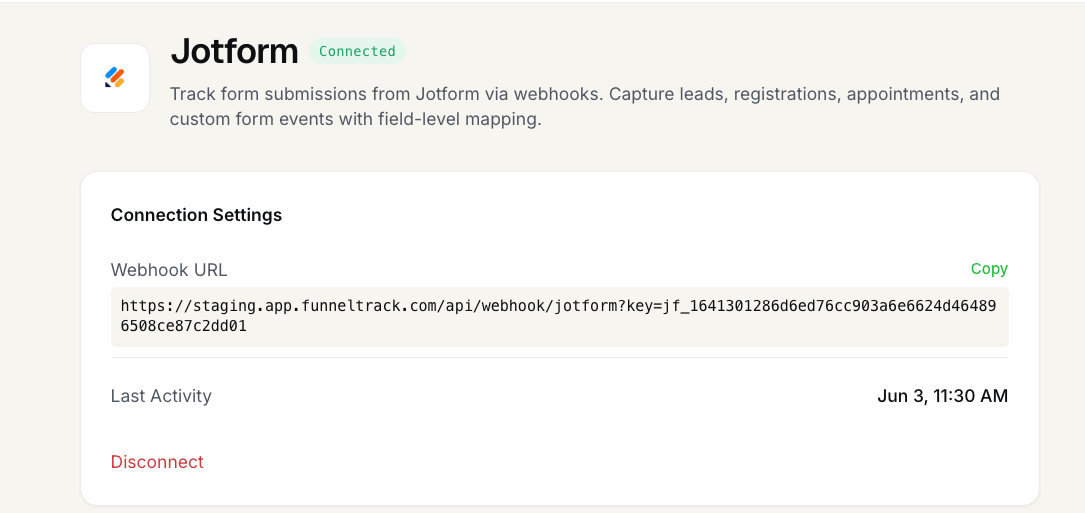
In FunnelTrack, open Integrations → Sources → Jotform and copy the Webhook URL shown on the connection page. This is the single endpoint every Jotform form in your workspace will post submissions to.
Add the FunnelTrack webhook to each Jotform form
Open the form you want to track in Jotform's Form Builder. From the top nav, go to Settings → Integrations and pick Webhooks from the catalog.
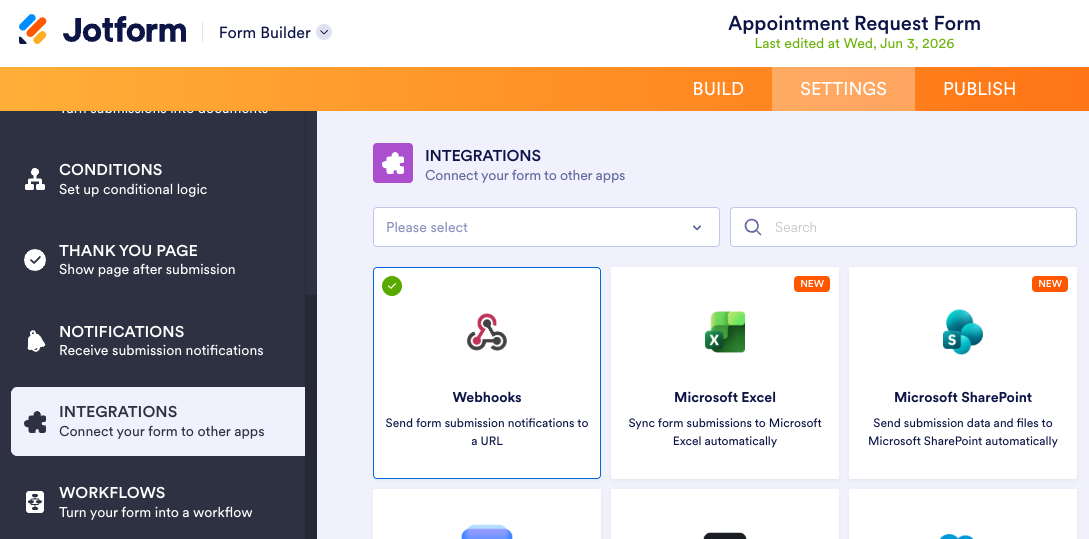
Paste the FunnelTrack webhook URL from step 2 into the Add WebHook field, click Add New Web Hook, then Complete Integration.
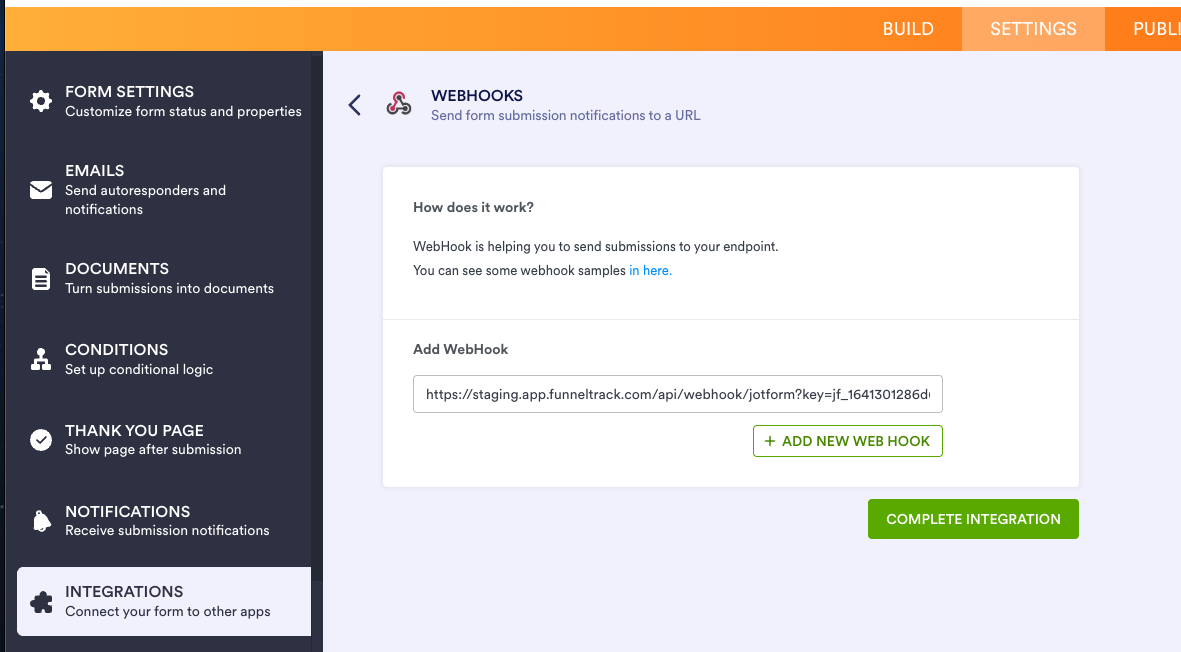
Once the webhook is saved, submit a quick test entry on the form so FunnelTrack has a sample payload to work with in the next steps.
Add a form-submission event in a connected destination
In FunnelTrack, open a connected destination's routing page (e.g. Jotform → Meta Conversions API). You'll see an All Form Submissionstemplate card already in the list — this fires for every Jotform submission in the workspace, no matter which form it came from. Pick a destination event (e.g. Meta's Lead), flip the toggle on, and save. Done.
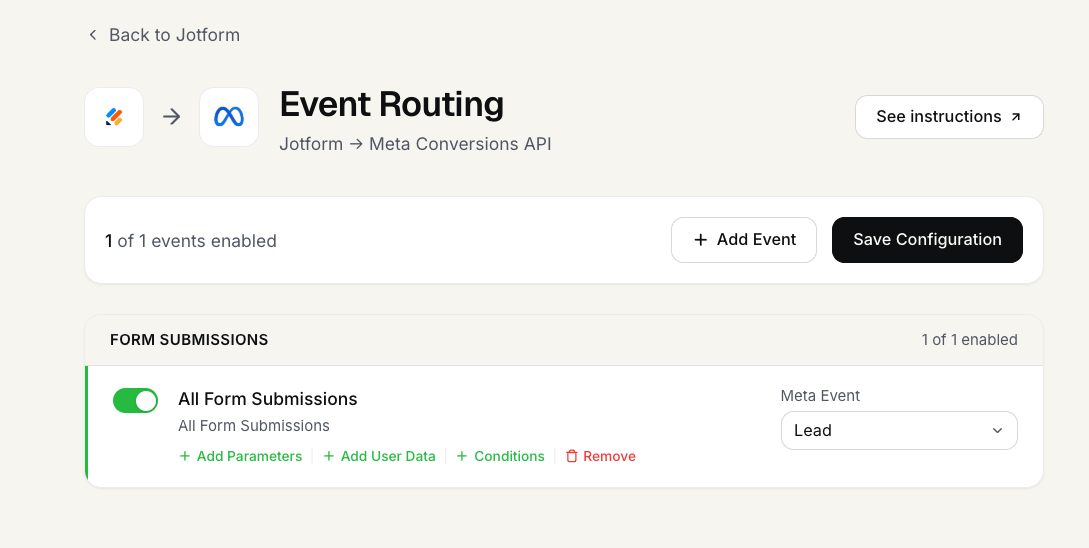
Lead, another fires Schedule) or when you want to map specific form fields into the event payload.(Optional) Build a custom per-form event
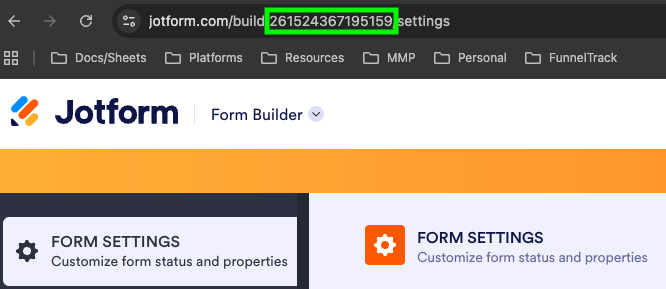
For per-form precision, click Add Event on the same destination routing page. The Add Event modal asks for a Form ID — you can find it in Jotform by opening the form editor and copying the long numeric ID from the URL:
Paste the form ID into the modal and click Find Last Submission. FunnelTrack pulls the most recent submission for that form and surfaces every field it found (Jotform field names are qN_fieldName-style — e.g. q3_fullName.first, q5_emailAddress). Give the event a name that'll show up on the destination's outbound usage logs, then pick a destination event below.
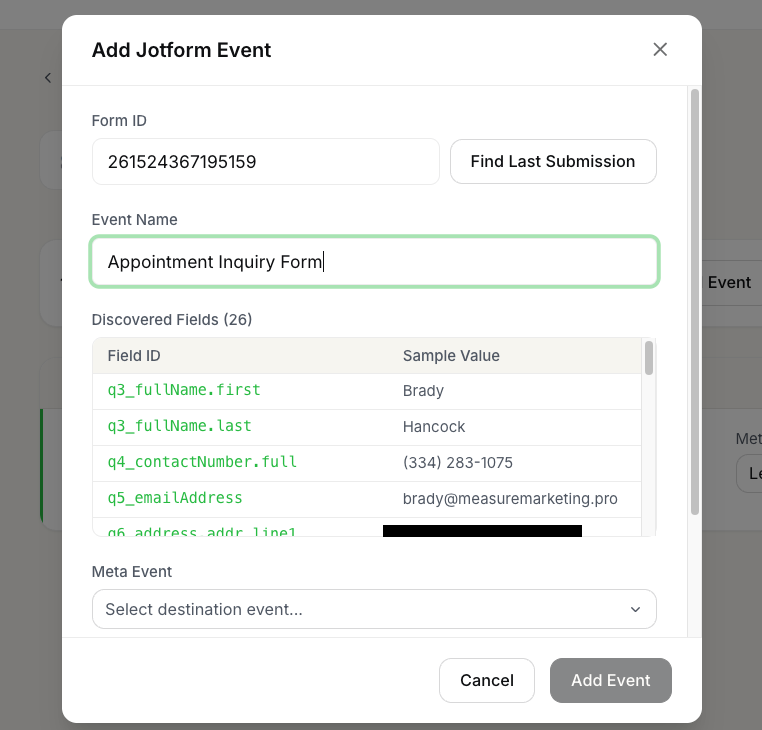
(Optional) Map event parameters
Two kinds of parameters can be mapped on the event:
- •Event Parameters — static values you type in (e.g.
currency: USD) or dynamic values pulled from form fields (e.g.form_titlepulled fromformTitle). These are sent to the destination as standard or custom event parameters. - •User Data Parameters — FunnelTrack auto-captures email, phone, name, and address fields from the Jotform submission. If your form collects identity data for more than one person (e.g. a referral form with both the referrer's and referee's emails), use the User Data section to manually map which form field is the primary contact for matching.
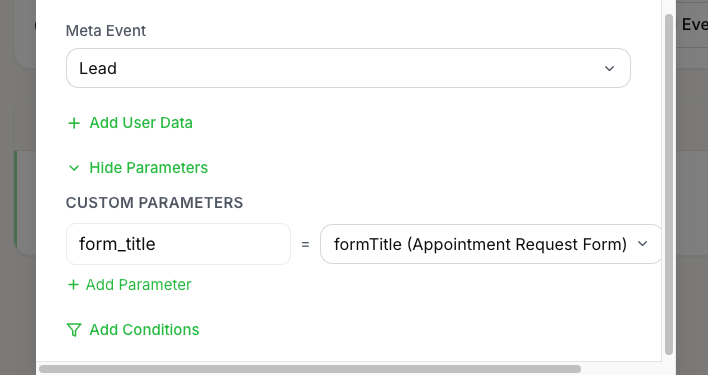
(Optional) Set event conditions
Use the Conditions section to fire the event only when the submission matches certain criteria — for example, only count a pricing-form submission as a lead when the budget field is over $5,000, or only fire a Meta Schedule event when a specific appointment-type field is selected.
Test & deploy
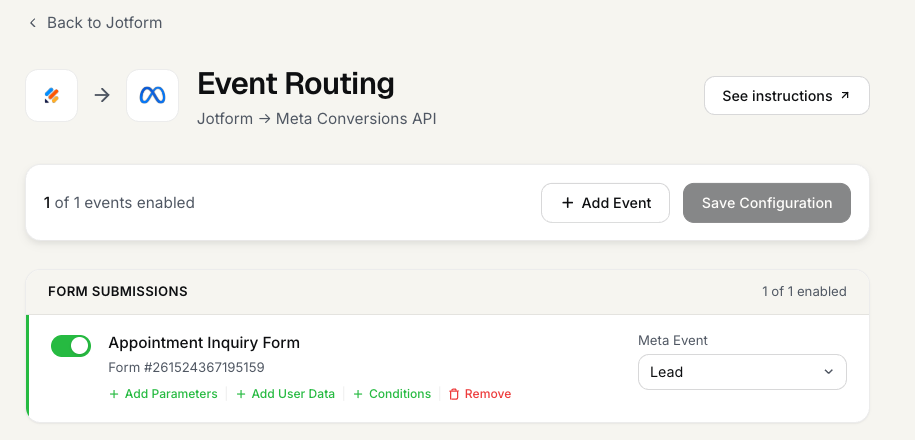
Save the event card. Submit a final test entry on the form — the saved card on the routing page shows the event as configured, the inbound usage log shows Form {{ID}} (e.g. Form 261524367195159), and the outbound log shows the event name you set being dispatched to the destination.
Notes & best practices
A few things worth knowing before you scale this across every Jotform on your site.
- •One webhook URL, many forms.Your workspace has a single FunnelTrack Jotform webhook URL — use it on every form's Webhook integration. Jotform sends the form ID inside the payload so FunnelTrack can route to the right event config without separate URLs per form.
- •All three Jotform form types work.Inline embeds, iframes, and standalone (non-embedded) form pages all fire the webhook the same way. Match quality is best when the FunnelTrack pixel is loaded on the page where the form is displayed — for embeds and iframes that's your own site; for standalone Jotform pages it lives at
form.jotform.comand the pixel can't run there, so FunnelTrack relies more heavily on identity backfill from email/phone in those cases. - •Redirects to a thank-you page are optional. Jotform's Webhook integration fires server-side at submit time, so the conversion is captured regardless of whether the user is redirected to a thank-you page afterwards.
- •All Form Submissions vs. per-form events. The All Form Submissions template is the fastest setup when every Jotform should map to the same destination event. Build per-form events when forms differ (different destination events, different parameter mappings, or different firing conditions).
Events we support
What Jotform can send to FunnelTrack out of the box.
Jotform ships one event type through the Webhook integration: a form submission. FunnelTrack receives the full submission payload and discovers every field the form contains, so you can map any of them to event parameters or user data on the destination side.
There's no fixed event catalog here — each form's submission is the event, and the form ID is the discriminator FunnelTrack uses to route it to the right destination config. The All Form Submissions template is a workspace-wide catch-all that ignores form ID and matches every Jotform submission.
Common tracking examples
A few patterns most FunnelTrack accounts end up running.
- •Every Jotform → Meta Lead, no per-form config. Enable the All Form Submissions card on Jotform → Meta and pick
Lead. Every submission, every form, gets sent as a Meta Lead. Five-second setup. - •Appointment Inquiry → Meta Lead + Google Ads Lead conversion. Same form, two destinations. Add the form ID once under Jotform → Meta and again under Jotform → Google Ads, both naming the event
Appointment Inquiry Form. - •Pricing form with conditions → only fire if budget > $5k. Build a per-form event, then use the Conditions section to gate the dispatch behind a budget-field check so low-intent submissions don't pollute your paid-ad reporting or skew downstream bid optimization.
FAQs
Ready to set it up?
Jump straight into your FunnelTrack workspace and start wiring up your first Jotform.
Configure your Jotform integration →Need a hand?
If anything in this guide didn't match what you're seeing in Jotform or FunnelTrack, open a support ticket in your dashboard and we'll get you sorted.